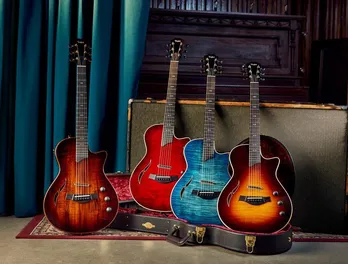
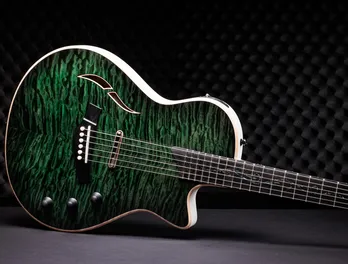
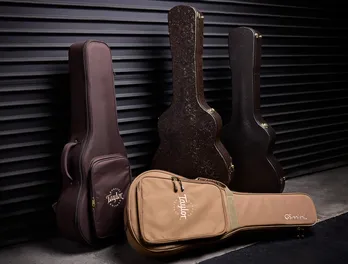




Fifty Liberty Tree T5 guitars will be made in all, each individually identified by the name of a state and a numeral that corresponds with the order in which the state entered the Union. The guitars will also come with a special custom case.

Top: Liberty Tree Tulip Poplar
Body / Neck: Mahogany
Peghead Inlay: Post-Revolution American Flag
Fretboard Inlay: Mother-of-Pearl Stars
Top Inlay: Revolutionary Period Battle Pennant
Body / Neck / Headstock Binding: Figured Maple with Red, White and Blue Purfling
Peghead Backstrap: Liberty Tree Tulip Poplar
Back Cover Panel: Satin-finish maple with Liberty Tree tulip poplar inlay and “Liberty” laser-etched
Tuners: Vintage Gotoh with Antique Gold Finish
To read our complete account of the Liberty Tree, read John D’Agostino’s thoroughly researched cover story from our Wood&Steel Winter 2002 issue (viewable at taylorguitars.com/news /community/ woodandsteel.html). A documentary DVD on the Liberty Tree is also available through TaylorWare.

Historic Liberty Tree wood left in limbo finds a sweet home atop the T5

When it comes to making guitars, Bob Taylor doesn’t spend much time peering into the past for inspiration. But there are occasions for exception. One notable one was the Liberty Tree, a quiet but resolute living witness to the American Revolution and well beyond; a symbol of freedom and community during the turbulent growing pains of a new nation; and later, an icon of endurance over the 400-year span of its life.

When the tree’s time had come, Bob was given the privilege of paying homage to its inspiring legacy through his craft. Sometimes building a guitar is a labor of love. The Liberty Tree Guitar was also a labor of reverence.

Released in 2002, the limited edition Liberty Tree Guitar, a Grand Concert, incorporated backs and sides of tulip poplar from the tree. Due to the tree’s decay in the later part of its life, a limited amount of wood was available, but Bob made the absolute most of it and was able to build about 400 guitars. Though the residual wood pieces were too small for a full-size guitar, they were used to make veneer for a limited offering of very special Baby Taylors, again about 400 in all. While some wood still remained, this time it seemed certain that no additional guitars could be made from it, as Bob explains.

“When we made the original Liberty Tree Guitars, I stood there disappointed when there were fifty-some backs with no sides and people begging for more guitars to be made,” he says. “We couldn’t do it. I had no idea what would ever become of that wood, but I couldn’t bring myself to the point of throwing it away. We locked it up and forgot about it. Little did we know that we’d develop the T5 and have another opportunity for a guitar which doesn’t need sides. It’s an honor to be able to use the last few pieces of this tree to make something as totally cool as this guitar.”

The last surviving Liberty Tree, a majestic tulip poplar, stood on the grounds of St. John’s College in Annapolis, Maryland until September of 1999, when it sustained irreparable damage from Hurricane Floyd after four centuries of life. During the colonial period of the American Revolution, each of the original 13 colonies had adopted Liberty Trees (or, in some cases, Liberty Poles), where members of the public would congregate for speeches, protests and other assemblies during their struggle for independence from Great Britain.

In 1774, the Annapolis Liberty Tree prominently figured in the town’s variation on the Boston Tea Party. When a ship sailed into Annapolis harbor with a large cargo of tea, its owner hoped to unload it and quietly pay the reviled Tea Tax. Hearing this, an angry mob gathered under the tree, then marched to the owner’s house with an ultimatum: He could burn the ship and its cargo, or be hanged right there at his front door. The owner ran his ship aground and set it ablaze with his own torch.

In 1824, Marquis de Lafayette returned to America to be honored for his role in the American Revolution. During a ceremony in Annapolis, Lafayette stood in the shadow of the Liberty Tree and announced that in the aftermath of the successful revolution in his own country, more than 60,000 Liberty Trees had been planted in France.

Through much of the 19th Century, the Liberty Tree would be a favorite touchstone for statesmen, dignitaries and Presidents, and a popular site for Fourth of July picnics and other civic events. By the early 20th Century, the Liberty Tree was suffering from decay that had reduced its trunk to a hollow shell only 13 inches thick. In 1907, a landscape architect cleaned out the tree’s interior, then filled the cavity with 55 tons of concrete reinforced with steel and iron. Though the tree would outlive the average lifespan of a tulip poplar by almost a century, the severe damage inflicted by Hurricane Floyd would ultimately necessitate its removal for safety reasons.

On October 25, 1999, St. John’s hosted a special ceremony to honor the tree while it was still standing. Hundreds of spectators heard speeches by the Governor of Maryland and other dignitaries. After its removal, Bob Taylor heard about the tree through Emory Node, owner of Appalachian Bluegrass Shoppe in Baltimore. A lover of American history, Bob was fascinated by the Liberty Tree saga, but assumed that any salvaged wood from the tree would already be spoken for.

St. John’s saved parts of the tree for posterity; the trunk and large sections of branches were hauled away to three different destinations, including a landfill in Millersville, Maryland. When a local landscaper, Mark Mehnert, learned of the Liberty Tree’s fate, he decided to rescue the wood from the dump. He moved it to a climate-controlled section of a warehouse at his own expense. A few months later, out of the blue, Bob Taylor received an urgent voicemail from Mehnert, asking if he was interested in buying the wood. Mehnert explained that he needed an answer right away because he was going broke and needed a quick infusion of cash to pay off creditors. Bob immediately agreed, and the rest, as they say, is history.


You need to upgrade your computer's Flash Player Please download the latest flash player here.

Note: you may need to restart your browser or your computer to complete the flash player installation.
See the story of the Liberty Tree here.