



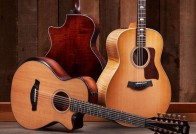
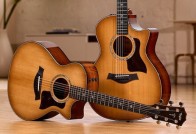
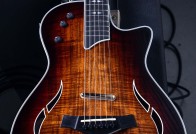
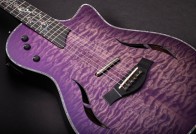















A midrange powerhouse. Mahogany is prized for balance and articulation, making it one of the best all-around tonewoods there is.
Indian Rosewood
The tonewood superstar. Popular, traditional, and versatile, Bob Taylor puts Indian rosewood among the greatest tonewoods ever.
Big Leaf Maple
High-end sparkle and incomparable good looks put maple in its own category.
Hawaiian Koa
Few woods carry the allure of Hawaiian koa, with its gorgeous figure and sweet, complex tone.
Walnut
Walnut’s crisp highs are balanced by a deep, woody low end that emerges as the guitar is played in.
Cocobolo
A cannon of a guitar, with exotic coloration and figure to match its bold voice.
Ovangkol
Although not as well-known as its Indian rosewood cousin, ovangkol shares many of the same properties, making it a versatile, great-sounding tonewood.
Sapele
One of the best all-around tonewoods there is, sapele will deliver for any playing style.
Rosewood Laminate
A rosewood veneer and laminate construction present a beautiful aesthetic in a durable, affordable package.
Sapele Laminate
Laminate construction is used to offer attractive, durable and affordable models.
Maple Laminate
Maple veneer is part of the resilient laminate construction on the black 214ce-BLK.
Blackwood Laminate
A blackwood veneer with laminate construction blends exotic beauty, resilience and affordability.
Quilted Sapele
Besides boasting gorgeous figure, the tone enhances sapele’s “bright mahogany” voice with extra low-end warmth.
Tasmanian Blackwood
Koa's cousin produces a similar tone, with a breathy midrange and bright treble notes, plus low-end overtones.
Macassar Ebony
Macassar’s exotic beauty is matched by a bold, dynamic tone that can be dark or bright, depending on the player and the top pairing.
Koa Laminate
Koa veneer is part of the resilient laminate construction on the 210ce-K and 214ce-K.
Granadillo
Sonically comparable to rosewood, granadillo’s higher density yields a clear, ringing tone.
African Ebony
A dense wood typically used for fretboards and bridges, ebony produces rich overtones.

Origin: Western North America
Used On: The 700 Series, 510ce, 516ce, DN7, Limited Editions, Custom Guitars
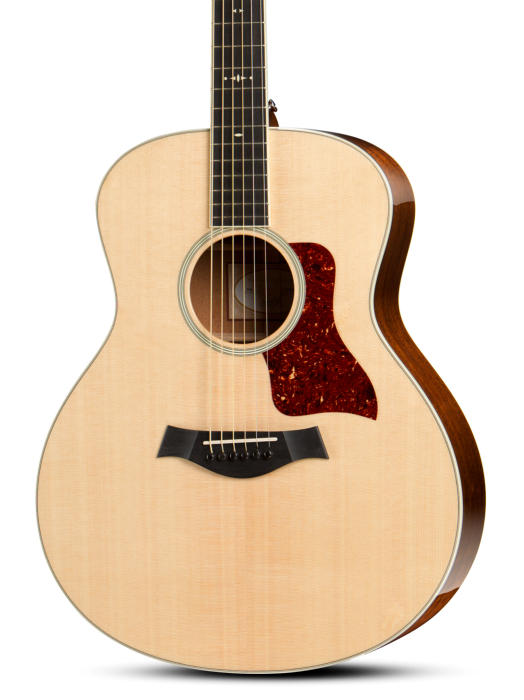
Engelmann is also known as white, European or German spruce, although they are technically different species. It is usually visually distinguishable from Sitka by its creamier complexion. We're almost out of the “good stuff.” Engelmann trees these days are so small and twisted that we get a fair amount of runout (grain that doesn't run parallel to the surface) and as a result, mismatched tops.
Sonically, Engelmann has a mature tone, and yields a slightly richer midrange than Sitka, which makes a guitar sound a bit older. Old growth Engelmann tends to have a sonic attribute of smoothness or refinement to it, but the days of older growth Engelmann trees are essentially gone for now.
Goes Well With: All styles of guitars and players.